


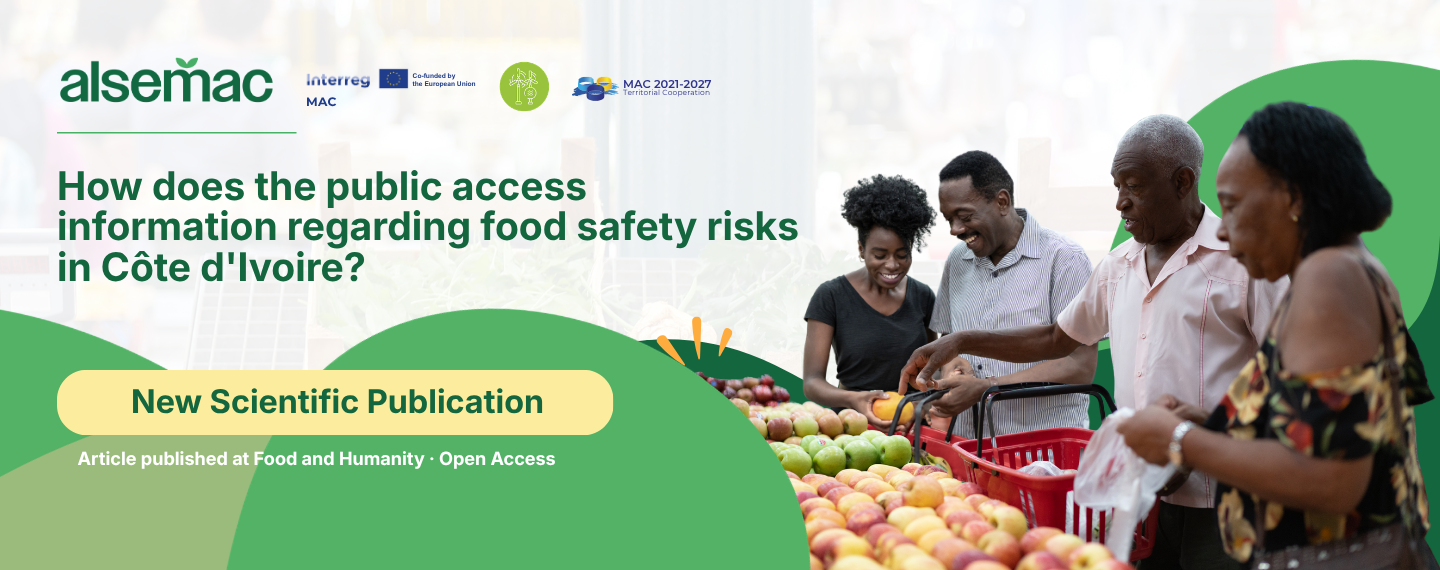
Research identifies gaps between the importance consumers attach to food risks, the information they feel they have, and their access to trusted sources
A scientific paper linked to the ALSEMAC project has examined how urban consumers in Côte d’Ivoire perceive food risks and access information about food safety. Published in Food and Humanity, the research offers new evidence on how people receive, consult and assess information related to food safety.
The study is based on an online survey of 402 digitally reachable adults living in urban areas of Côte d’Ivoire. It explored the importance respondents attach to food risks, whether they feel sufficiently informed, the level of trust placed in different information sources, and how often those sources are consulted.
The findings identify three connected gaps. The first concerns relevance and information sufficiency: respondents regarded food risks as highly important, but did not feel equally well informed to identify, interpret and manage them. On a scale from 0 to 10, the personal relevance of food risks received an average score of 8.59, compared with 6.54 for the feeling of being sufficiently informed.
The second gap relates to trust and everyday reach. Doctors and medical specialists were the most trusted source of food-safety information, followed by international organisations and scientists working in universities or public research centres. However, these sources were not necessarily the ones consulted most frequently.
Family and friends were the most frequently consulted source. Scientists ranked third for trust but tenth for consultation frequency, while doctors ranked first for trust and sixth for regular consultation. The paper describes this difference as a “credibility–accessibility gap”.
A third gap was found between concern and information exposure. For each of the eight food-safety issues covered by the survey, respondents’ concern was higher than the level of information they reported receiving. The widest differences were found for microplastics in food, contamination during transport or poor storage, genetically modified foods and pesticides.
The findings should not be read as a lack of public interest. On the contrary, they point to strong concern about food safety and to the need for reliable scientific and technical knowledge to reach people through the communication channels they use in everyday life.
The study recommends linking trusted experts and institutions with high-reach settings and channels, including media outlets, markets, local retailers, community networks, consumer organisations and digital platforms. It also highlights the value of tailoring communication to different issues: practical messages for familiar matters such as hygiene and food-borne illness, and clear technical explanations for less visible issues that require specialist interpretation.
The research is a scientific contribution associated with ALSEMAC and provides an evidence base for future food-safety awareness activities in Côte d’Ivoire and across the project’s participating territories. Its central message is that better communication is not simply about producing more information; it is about ensuring that reliable knowledge reaches people through the channels embedded in everyday food choices.
The article, Trusted but underused: The credibility–accessibility gap in food-safety risk communication among urban consumers in Ivory Coast, was authored by Raimundo Otero Enríquez, Giulia Uccheddu, Eva Parga Dans and Pablo Alonso González. The research was funded through the Interreg MAC 2021–2027 Territorial Cooperation Programme via the ALSEMAC project, co-financed by the European Union.
